
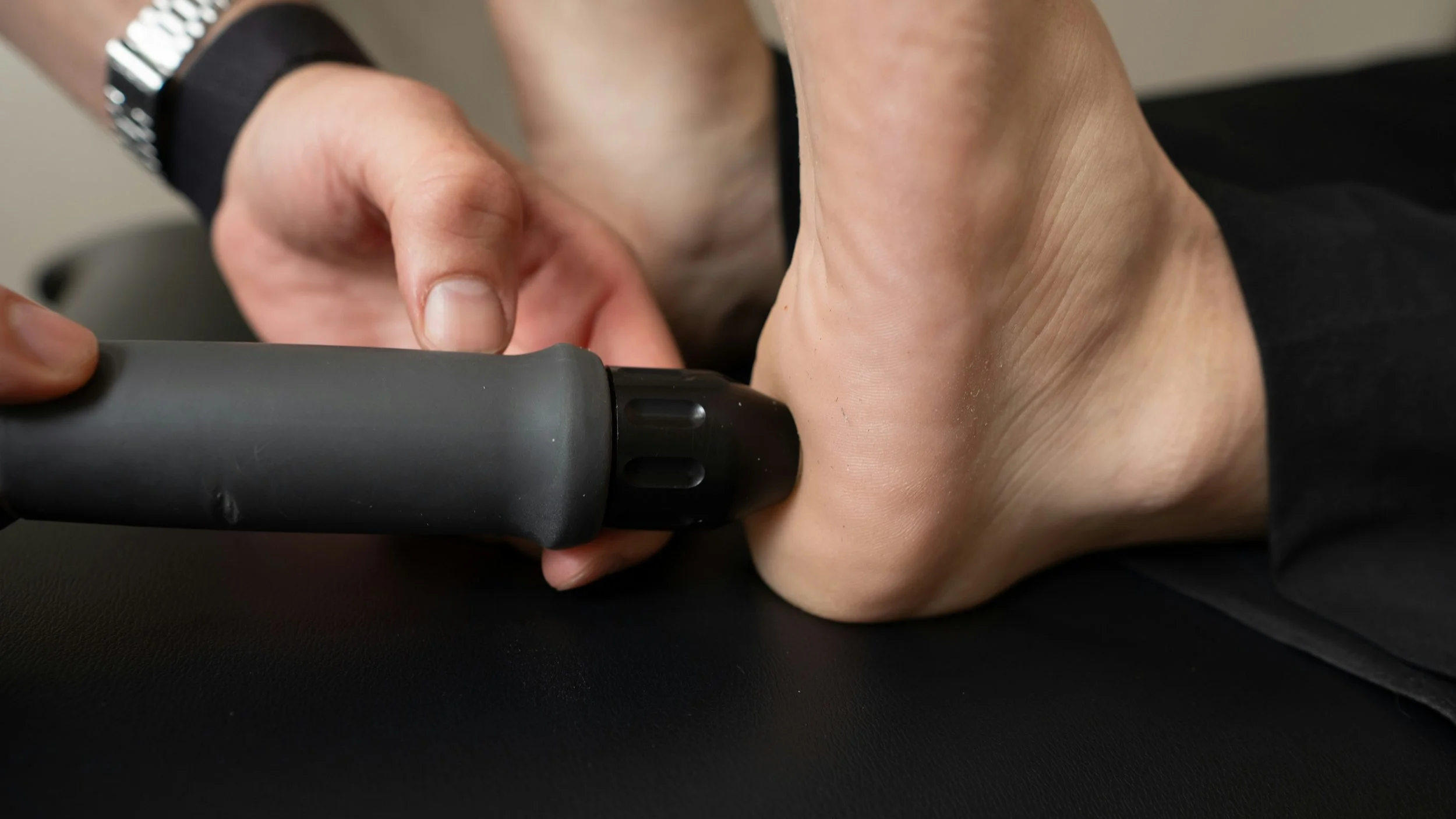
Massage guns have surged in popularity over the last several years. Brands like Theragun and Hypervolt are now commonly used by professional sports organizations, physical therapy clinics and everyday gym-goers alike. But with price tags reaching $400–$600, many people wonder: do massage guns actually work, and are they worth the money? Let's look at what the research says.
What are massage guns designed to do?
Massage guns provide percussive therapy, delivering rapid, repetitive pressure to soft tissue. Like foam rolling, their primary goal is to target the fascia, the connective tissue surrounding muscles. When fascia becomes stiff or sensitive, it may contribute to decreased range of motion, feelings of tightness and discomfort after exercise.
Unlike foam rollers, massage guns allow more targeted treatment, making it easier to address smaller muscle groups and harder-to-reach areas. (For more on what these tools can and can't change, see the truth about fascia.)
Do massage guns improve range of motion?
Research suggests massage guns can be effective at improving lower-body range of motion, particularly compared with static stretching:
- Konrad et al. (2020) found that a single percussive massage with a Hypervolt led to greater improvements in ankle dorsiflexion than static stretching.
- Guzman et al. (2014) showed that a 5-minute hamstring treatment improved hip flexion range of motion.
- Patel & Patel (2020) reported increased hamstring flexibility and reduced perceived back pain after one week of daily Theragun use.
However, results aren't universal. Park (2020) found no significant changes in triceps range of motion after localized massage gun use. Massage guns appear to be more effective for lower-body mobility than upper-body mobility, though results may vary by muscle group and person.
Do massage guns improve performance?
Many athletes use massage guns as part of their warm-up, hoping to improve power or performance. Current research doesn't support this use:
- Hernandez (2020) found no improvements in vertical jump, countermovement jump or drop jump performance after Theragun use.
- Konrad et al. (2020) showed no changes in calf muscle force output after percussive massage.
- Similar findings have been reported with foam rolling, showing no significant improvements in jump height or take-off velocity.
Massage guns don't appear to enhance performance when used as a warm-up.
Do massage guns help with recovery and soreness?
This is where massage guns seem to shine. Multiple studies on vibration therapy, massage and foam rolling have shown benefits for reducing delayed onset muscle soreness (DOMS). Imtiyaz et al. (2014) and Cafarelli et al. (1990) found that vibration therapy applied after exercise reduced soreness and perceived muscle stiffness, and conventional massage and foam rolling have also consistently reduced DOMS.
Massage guns likely provide similar benefits by improving circulation, reducing muscle tone, and decreasing perceived tightness and soreness.
So, are massage guns worth it?
Massage guns do work, particularly for improving lower-body range of motion, reducing post-exercise soreness and supporting recovery. However, they haven't been shown to improve strength or power output, or to enhance performance when used as a warm-up.
Whether a massage gun is worth the investment ultimately depends on your recovery needs, your training volume and your budget. It's one of many tools that can support recovery, but it isn't essential. Foam rollers, mobility work, proper programming, sleep and nutrition remain foundational.
Not sure whether a massage gun fits your goals? Our physical therapists and performance coaches can help you build a recovery routine that works.
book a sessionthe takeaway
Massage guns can improve lower-body range of motion and help reduce post-exercise soreness, but they don't boost strength, power or warm-up performance. They're a nice-to-have recovery tool, not a must-have: sleep, nutrition, mobility work and good programming matter more.
Frequently asked questions
Do massage guns actually work?
They appear to help with lower-body range of motion and post-exercise soreness, but research hasn't shown that they improve strength, power or performance.
Should I use a massage gun before a workout?
You can for comfort or mobility, but studies found no improvements in jump performance or calf force output after percussive massage, so don't expect a performance boost.
Are massage guns better than foam rollers?
They work toward similar goals. Massage guns allow more targeted treatment of small or hard-to-reach areas, while foam rollers are a cheaper option with similar recovery benefits.
Is a massage gun worth $400?
It depends on your recovery needs, training volume and budget. It can support recovery but isn't essential.
References
Konrad A, Glashüttner C, Reiner MM, Bernsteiner D, Tilp M. The acute effects of a percussive massage treatment with a Hypervolt device on plantar flexor muscles' range of motion and performance. J Sports Sci Med. 2020;19(4):690-694. PMC7675623
Imtiyaz S, Veqar Z, Shareef MY. To compare the effect of vibration therapy and massage in prevention of delayed onset muscle soreness (DOMS). J Clin Diagn Res. 2014;8(1):133-136. doi:10.7860/JCDR/2014/7294.3971
Cafarelli E, Sim J, Carolan B, Liebesman J. Vibratory massage and short-term recovery from muscular fatigue. Int J Sports Med. 1990;11(6):474-478. doi:10.1055/s-2007-1024840