
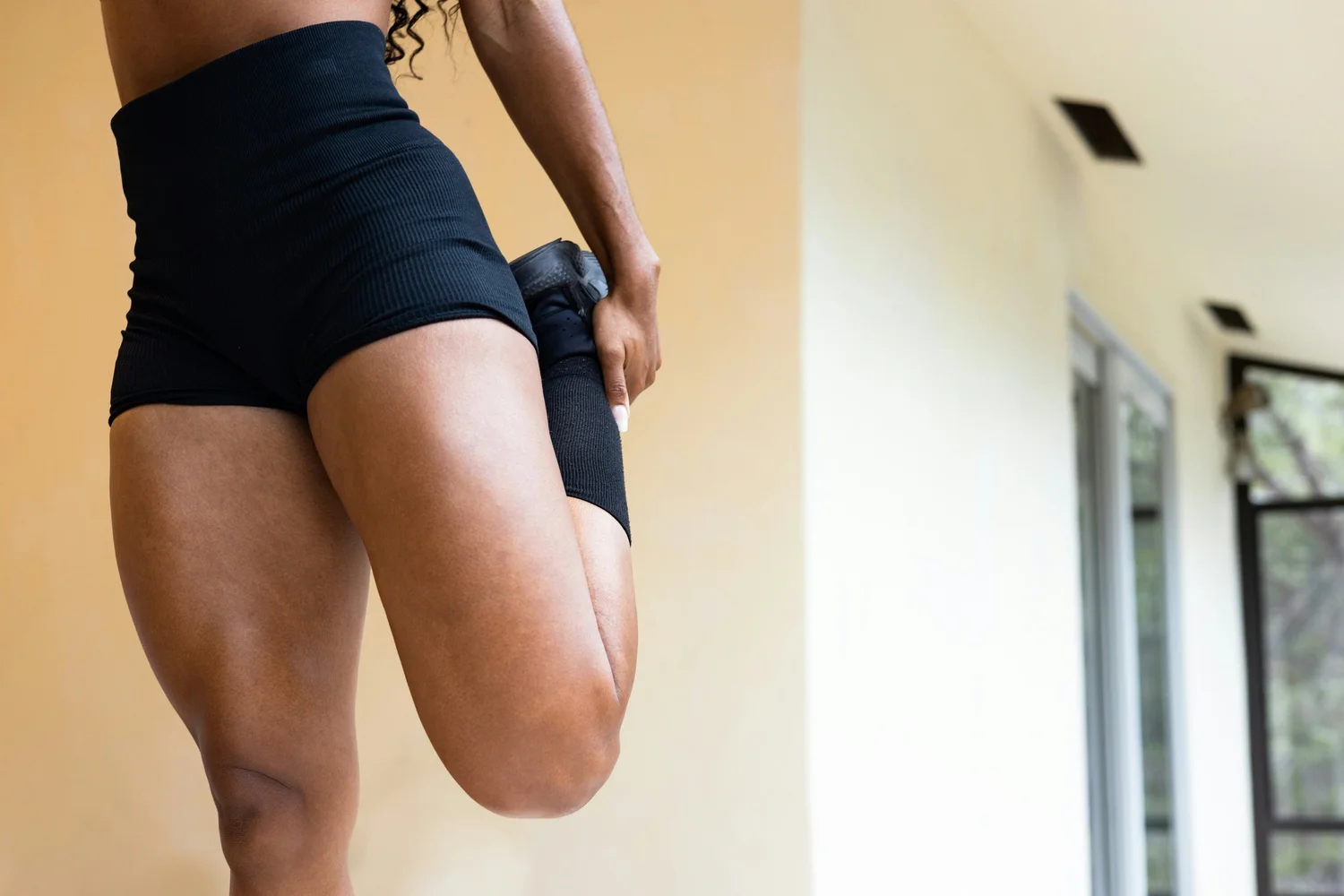
The most-asked questions following knee surgery are, "Where did my quad go?" and "Why isn't it working?"
Whether it's a total knee arthroplasty (TKA), ACL (anterior cruciate ligament) reconstruction, or meniscal repair, the quadriceps often experience a rapid decline in both size (atrophy) and strength (function). The loss used to be blamed on simple disuse, but current science reveals it's more complex and largely a neurological process. It's a triple threat: your brain shuts off the signal, your muscle cells lose their power, and the tissue itself begins to change quality. Let's break down what's happening.
Arthrogenic muscle inhibition: the emergency shutoff switch
The most significant finding in recent years is arthrogenic muscle inhibition (AMI). Even though the goal of surgery is to help the knee, the body perceives surgery as trauma, and the resulting pain and swelling cause sensory nerves in the joint to send a "distress signal" to the spinal cord.
- The block: The nervous system blocks the electrical signals telling the quadriceps to contract, a safety switch that prevents you from fully using the muscle to protect the perceived injury.
- The brain gap: Research notes this happens at both the spinal level and in the brain's motor cortex. You try to squeeze the muscle, but the signal doesn't get through.
- Maladaptive neuroplasticity: AMI isn't just a temporary glitch. The brain can "rewire" itself to stop using the quad, a change that can persist long after the tissue has healed.
This is why restoring quad contraction through neuromuscular re-education and gradual progressive loading is one of the top priorities in early rehabilitation.
Morphological changes: loss of size and power
Type II muscle fibers
Muscle fibers are generally categorized as Type I (slow-twitch/endurance) or Type II (fast-twitch/power).
- Shrinkage: Type II fibers atrophy at a much faster rate than Type I fibers after surgery.
- Why it matters: Type II fibers drive high-force movements like standing from a low chair, climbing stairs, or catching your balance. When they shrink, you lose that power.
- Decreased efficiency: The proteins responsible for contraction also become less efficient, so even at 100% effort a Type II fiber produces less "kick" than before surgery.
The recruitment struggle
AMI makes it harder to recruit Type II fibers in the first place. The body normally recruits smaller Type I fibers first, then Type II fibers when quick or heavy movements are required. But AMI prevents the brain from reaching the high-threshold signals needed to switch the Type II fibers on, and if we can't turn them on, we can't strengthen them.
Cellular changes: mitochondrial decay
Muscle fibers rely on cellular health to recover and function. Research shows the mitochondria (the powerhouses of the cell) decrease in number and health in the quadriceps after surgery, which leads to faster fatigue (even if you get the Type II fibers to fire, they tire quickly) and delayed recovery, as the cells struggle to repair after activity.
Changes in muscle quality: muscle vs. fat
When a muscle is inhibited and not used, fat begins to infiltrate the tissue, similar to marbling in a steak. Notably, the "fat fraction" inside your quad is a better predictor of how well you'll walk and climb stairs than the actual diameter of your thigh.
How physical therapy combats these changes
Because strength loss happens so rapidly, often within the first 72 hours, the first few weeks of rehabilitation are critical to restore the neuromuscular connection before significant changes set in. Your physical therapist will guide you through reducing inflammation and pain with soft-tissue work, passive range of motion, and gradual movement, then show you how to load the quad safely. Strategies like electrical stimulation paired with quad contraction and blood flow restriction therapy can further help restore both size and function.
Rebuilding your quad after knee surgery? Kauno's physical therapists target the neuromuscular shutdown early so your strength comes back faster.
book a sessionthe takeaway
Quad weakness after knee surgery isn't just "disuse." It's a neurological shutdown, so early rehab that reawakens the muscle matters as much as the strengthening that follows.
Frequently asked questions
Why does my quad shut down after knee surgery?
Largely because of arthrogenic muscle inhibition (AMI): the body perceives surgery as trauma, and pain and swelling cause the nervous system to block the signals that tell the quadriceps to contract.
Is quad weakness just from not using the leg?
No. Current science shows it's more complex: a mix of a neurological shutdown (AMI), faster shrinkage of powerful Type II fibers, mitochondrial decline, and fat infiltrating the muscle.
How soon should rehab start?
Early. Strength loss often happens within the first 72 hours, so the first few weeks are critical for restoring the neuromuscular connection before larger changes set in.
What helps restore the quad?
Neuromuscular re-education and gradual progressive loading are the priority, and tools like electrical stimulation paired with quad contraction and blood flow restriction therapy can help restore both size and function.
References
Moiroux-Sahraoui, A., et al. (2024). Quadriceps activation after anterior cruciate ligament reconstruction: the early bird gets the worm! International Journal of Sports Physical Therapy, 19(8), 1044–1051. https://doi.org/10.26603/001c.121423
Forelli, F., et al. (2025). Rethinking the assessment of arthrogenic muscle inhibition after ACL reconstruction: implications for return-to-sport decision-making. Journal of Clinical Medicine, 14(8), 2633. https://doi.org/10.3390/jcm14082633
Importance of attenuating quadriceps activation deficits after total knee arthroplasty. Phys Ther Rep (2022).
Effects of total knee arthroplasty on skeletal muscle structure and function at the cellular level. Journal of Applied Physiology (2022).
Role of thigh muscle changes in knee osteoarthritis outcomes. Radiology (2022).
Quadriceps intramuscular fat fraction rather than muscle size is associated with function. Osteoarthritis and Cartilage.
Effects of neuromuscular electrical stimulation and blood flow restriction training on muscle function in ACLR patients. International Journal of Environmental Research and Public Health (2022).
Paravlic, A. H., Meulenberg, C. J., & Drole, K. (2022). The time course of quadriceps strength recovery after total knee arthroplasty is influenced by body mass index, sex, and age of patients: systematic review and meta-analysis. Frontiers in Medicine, 9, 865412. https://doi.org/10.3389/fmed.2022.865412